Hand-knotted in Pakistan · Since 1972
Latif Enterprises
Click anywhere to begin
Hand-knotted in Pakistan · Since 1972
Latif Enterprises
Click anywhere to begin
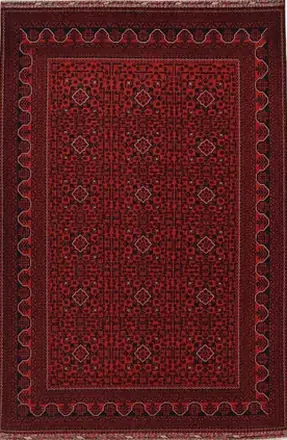
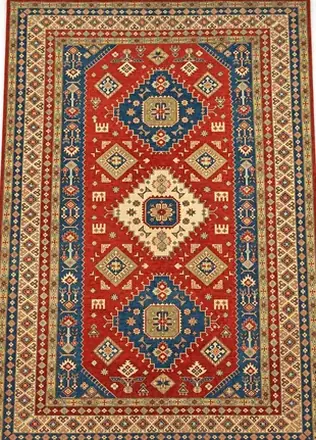
A hand-knotted wool rug from Latif Enterprises, Lahore: a deep madder red field with an eight-pointed central medallion in ivory and indigo, and a triple running border.
Hand-knotted in Pakistan · Since 1972
Every rug we create is exclusively hand-knotted in Pakistan. The finest wool and pure silk are entrusted only to master weavers, many of whom have worked with us for generations. Every Latif Enterprises rug carries more than five decades of family experience, and is made entirely under our direct supervision from the first spun thread to the final knot.
Email: info@latifenterprises.com Email: alatifcarpets@gmail.com Phone: +92 42 3636 3140
Scroll
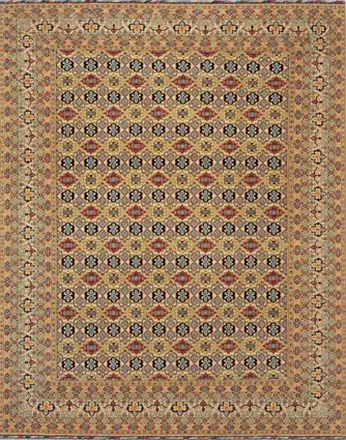
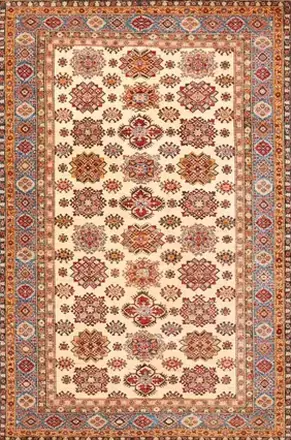
A wool kilim from Latif Enterprises lying back behind the four figures: row on row of small stepped diamonds in saffron, coral, teal and plum on an ivory ground, inside a wide sage-green border.
Four Pillars of Our Heritage
Our history at a glance:
A hand-knotted rug on a madder-red field set with rows of small ivory, indigo and gold medallions inside a wide ivory border, shown rolled and then unrolled across the floor.
Chapter One · 1972
In 1972, Abdul Latif Malik began weaving on a single hand loom in Lahore, choosing to preserve the pure art of hand-knotting. True artistry cannot be rushed; the patient months dedicated to tying each individual knot are the very reason a rug endures across lifetimes. For decades, our unwavering commitment to the pieces that carry our family name has connected us with discerning buyers who value true provenance, many of whom we still supply today.
Three identical hand-knotted rugs from the same Lahore looms, laid side by side: a mint-green field with a column of stepped gold and red medallions, inside a wide madder-red border of ivory rosettes.
Chapter Two · Growth & Reputation
From the beginning, our business has grown through trust rather than advertising. Buyers who were satisfied with our work recommended us to others, and many of our first orders from abroad became long-term business relationships that continue to this day.
As global appreciation for our rugs grew, the second generation chose to perfect the product, not merely to increase output. They sourced even finer wool, retained natural dyeing and brought the most accomplished weavers into the workshop.
Every stage of production, from raw wool to the finished rug, is carried out in-house and under our direct control. This is why the character of our work has remained consistent since our earliest days:
Two hand-knotted portrait rugs from the Latif Enterprises workshop in Lahore: Abdul Latif Malik and Malik Muhammad Azam, each woven in wool on a warm ivory ground inside a narrow floral border of madder red, indigo and gold.
Leadership · One Family, One Name
Founder & Permanent Patron-in-Chief, Pakistan Carpet Manufacturers and Exporters Association (PCMEA)
One of the most respected figures in Pakistan’s carpet industry, Abdul Latif Malik established the principles on which this company was built. His exacting eye for wool, colour and craftsmanship remains the final measure of every rug we produce.
“In 1972, I founded this company with a single objective: to manufacture hand-knotted carpets of uncompromising quality.
Quality of that order cannot be delegated. We therefore established our own woollen mills and dyeing plant, ensuring that every carpet is produced under our supervision, from the first thread to the final knot. As our production grew in scale, we took Pakistani hand-knotted carpets to markets around the world.
I have always believed that a business carries obligations beyond its own success. In 1994, I was elected Chairman of the Pakistan Carpet Manufacturers and Exporters Association (PCMEA), an office the industry has entrusted to me on four occasions. During my tenures, I signed three agreements with the International Labour Organization (ILO), the first in 1998. I now serve as the Association’s Permanent Patron-in-Chief.
Many of the carpet qualities now recognised throughout the market were first introduced by our company, among them:
More than fifty years on, my dedication to this craft, and to the people who sustain it, is undiminished.”
Abdul Latif Malik
Chairman, Task Force for Industries & Production, Ministry of Industries & Production, Government of Pakistan
Chairman, Pakistan Tanners Association (PTA)
Malik Muhammad Azam leads the company’s operations and global business. A prominent voice in Pakistan’s industrial and export sectors, he has strengthened the company’s standing in overseas markets while safeguarding the heritage on which its reputation rests.
“Excellence is not something we pursue at Latif Enterprises; it is the standard from which we begin. Every rug that bears our name must stand as the finest expression of the craft. That principle has guided us through more than half a century, and it will define our ambitions for the half-century to come.
A hand-knotted rug of genuine quality is not a transient purchase; it is an enduring asset whose value appreciates with the passage of time. That value is never a matter of chance. It is determined at the very outset, through the calibre of the wool, the integrity of natural dyes and the mastery of the weaver. Our role is to ensure that each of these elements is worthy of the investment our clients make.
As our international presence has expanded, we have developed robust systems of production and quality assurance, enabling us to fulfil substantial orders with the same precision afforded to a bespoke commission. Growth has never been an end in itself; it is meaningful only when consistency is maintained.
Our commitment extends well beyond the product. It encompasses the artisans whose expertise sustains this industry and the long-term partnerships we have built with clients across the world.
Ultimately, what we value most is trust: earned over decades of reliability and safeguarded with every order we deliver. I extend my sincere gratitude to our partners for their continued confidence, and I look forward to the next chapter of our shared success.”
Malik Muhammad Azam
A hand-knotted rug with a deep indigo field covered in coral, gold and ivory palmettes inside a madder-red border, turned over to show its back: the grid of individual knots row upon row, the same design reading through.
Our Craft · III. The Loom
A master weaver works the design row by row, often guided by a complex pattern committed to memory rather than one written on paper.
The exact count depends on the dimensions and density. An 8x10 carpet requires six to twelve months of skilled work, woven almost entirely by a single pair of skilled hands.
No two of our rugs are ever quite alike; small variations in the weaver’s touch make every piece distinct.
A hand-knotted pictorial rug from Latif Enterprises, with peacocks at its corners and songbirds in a cage at its centre on a gold and black ground, shown first in raw undyed wool and then in full colour as the dyes come into the pile.
Our Craft · I & II. The Wool and the Dye
We use premium hand-spun wool, carefully chosen for its staple length, inherent strength, and natural lustre. Those vital qualities determine how gracefully a rug will age, and they are settled long before the first knot is tied.
We turn to the earth for our palette: Madder root for deep reds, Indigo for rich blues, and Walnut husk for earthy browns. Natural dyeing is a slow process, and the subtle, organic variation from one dye lot to the next is precisely what collectors seek.
Yarn spun by hand carries slight irregularities. These give a hand-knotted rug its depth and its distinctive response to light, an effect that machine-spun yarn cannot reproduce.
A hand-knotted rug from Latif Enterprises on the washing floor: a deep navy field with a large ivory and turquoise medallion inside a cream border, shown dull off the loom and then washed clean and fully saturated.
Our Craft · IV & V. The Wash and the Finish
A finished rug comes off the loom looking muted. Washing opens the wool and brings out the full depth of the colours.
Shearing levels the pile using flat steel shears, just a few millimetres at a time. It is the most painstaking way to finish a rug, and the only way to keep the intricate patterns crisp and defined at the edges.
Six kinds of hand-knotted rug from Latif Enterprises, shown as a stack thrown back one at a time: a ruby Persian-style traditional rug, an ivory silk-ground rug with small flowering branches, an indigo Afghan Kazak with large geometric medallions, a sand and rust Ziegler, a fuchsia over-dyed rug, and a modern abstract rug in charcoal, ochre and sienna.
What We Make · Our Collections
From the classical to the contemporary, each of our designs can be woven to the size your space requires.
Signature Styles Featured on Our Floor
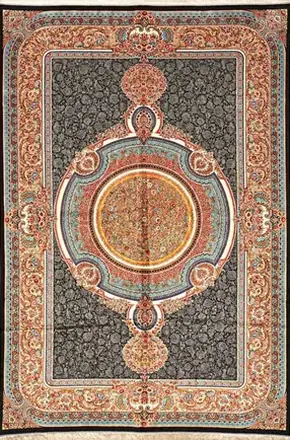
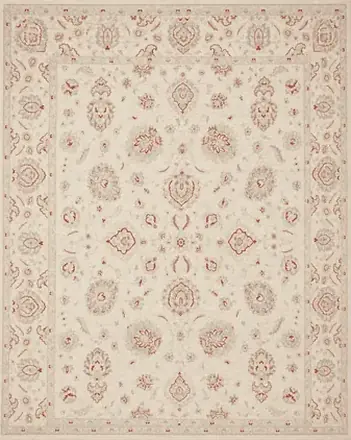
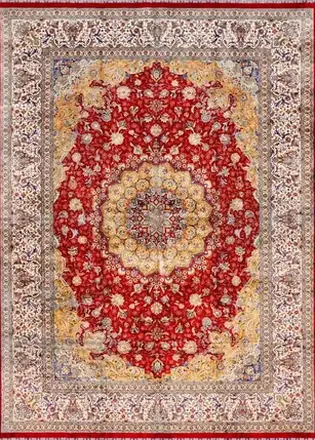
Classical Persian design featuring a central medallion, corner spandrels and a field of scrolling vines, knotted remarkably fine and dense.
The field is pure silk while the floral motifs upon it are wool, allowing the ground to catch the light one way and the pattern another. Paler, finer and slower to knot.
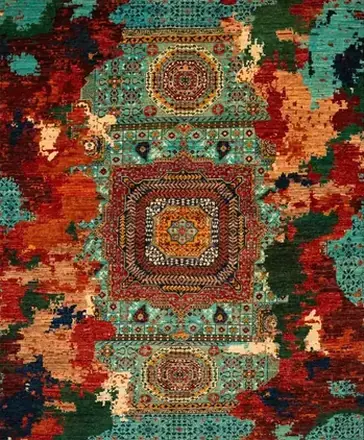
Bold, striking geometric medallions woven in thick, hand-spun wool. The subtle shifts of colour across the field arise naturally from the yarn itself.
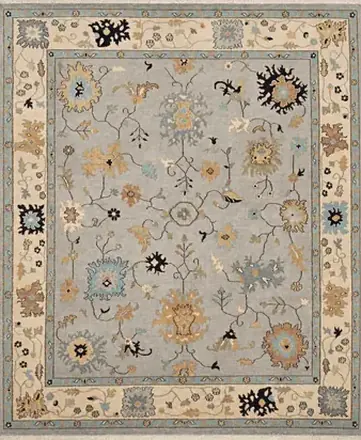
Large, open vines and graceful palmettes in tones of sand, rust and slate—a refined pattern that rests calmly in a room.
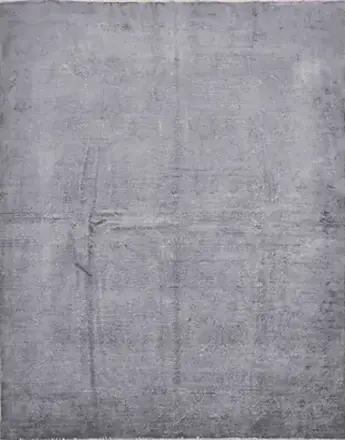
A classical design immersed in a single rich tone. The traditional pattern remains completely visible, carried through subtle shifts in texture rather than contrasting colour.
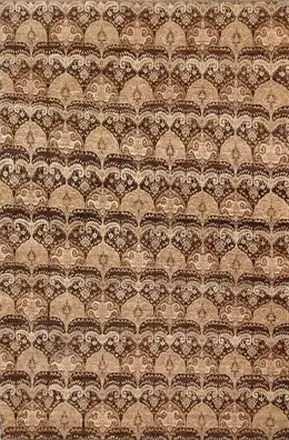
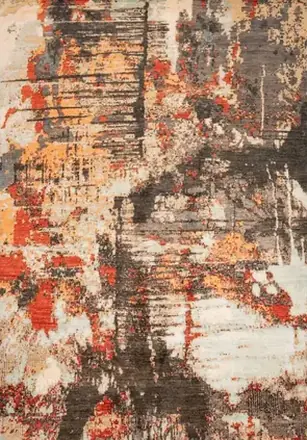
Contemporary, abstract designs knotted in charcoal, ochre, and sienna—crafted using the exact same traditional hand-knotting techniques as our classical pieces. Bring your own drawing, and we will weave it.
A very finely knotted rug from Latif Enterprises in wool and silk: a deep midnight-blue field with an intricate medallion and an all-over pattern of small palmettes and flowering vines in ruby, ivory and sky blue, its near corner turned back to show the grid of knots on the reverse.
Quality · The Two Inspections
Each takes time and is completed before a rug is wrapped, so the piece that arrives at your door is the same one we approved.
Turning back a corner of the rug reveals the exact knot density and whether the rows are perfectly aligned. Both are set by the weaver as the rug is tied, and neither can be altered afterwards.
Light cast low across the surface exposes even the slightest dip in the pile, a slack row or an uneven trim. It is the final and most rigorous check every rug undergoes on our floor.
A rug from Latif Enterprises in completely undyed wool, in the natural colours of the sheep: ivory, oatmeal, soft grey and dark brown, in a calm geometric design of stepped diamonds, lying still while the light of several days passes over it.
Responsibility · Built to Last
A hand-knotted wool rug serves a family for decades before becoming an heirloom for the next generation. Its longevity is determined by the quality of the fleece and the firmness of every knot.
Alongside our naturally dyed pieces, we also weave rugs entirely free of dye. Their calm, timeless tones are the sheep’s own: ivory, oatmeal, soft grey, and dark brown.
A hand-knotted runner from Latif Enterprises, long and narrow, with an ivory field of small scattered palmettes in soft red, blue and gold, carried a hand's width above a floor drawn as a map, travelling away from a mark where Lahore is.
Global Reach · From Lahore
Every rug is made in Lahore, the city where our story began, and from this point on the map, it sets out for buyers around the world.
Since 1980, our hand-knotted rugs have reached distinguished homes in the United States, Europe and international markets beyond. Today, we also supply buyers directly, with no importer in between.
A hand-knotted rug from Latif Enterprises on the loom in Lahore, madder red, ivory and indigo, with a weaver's two hands tying a knot at the top of the finished rows, where the bare cotton warp threads run up the loom, the camera closing until the single knot fills the frame.
The Artisans · The Custodians of the Craft
A single rug represents six to twelve months of an artisan’s working life. Many of our master weavers inherited their craft from a parent, who in turn learnt it from a grandparent.
Every weaver who works with us is a respected adult, compensated with a fair and dignified wage, a policy we strictly enforce throughout our operations.
You can commit a design to paper, but you cannot write down the exact tension of the thread, the feel of the shears or the instinctive judgement of when a row is sitting right. These skills can only be learnt through years of practice under an experienced weaver.
A hand-knotted rug from Latif Enterprises, seen from above and dead centre in a bright room: a tree of life with roses, pomegranates and birds on a deep navy field, framed in turquoise inside a wide madder-red border.
The Road Ahead · Partner With Us
With greater capacity, new designs and a steadily growing clientele, our business has evolved considerably. Our traditional method, however, has remained untouched since the day we began, and we have no plan to change it.
We export hand-knotted rugs in volume to importers, retailers, collectors and interior designers who want to know exactly where each piece was made. We offer:
Contact us to discuss custom orders, wholesale exports or our current range.
Powered by awamediapk.com
Loading